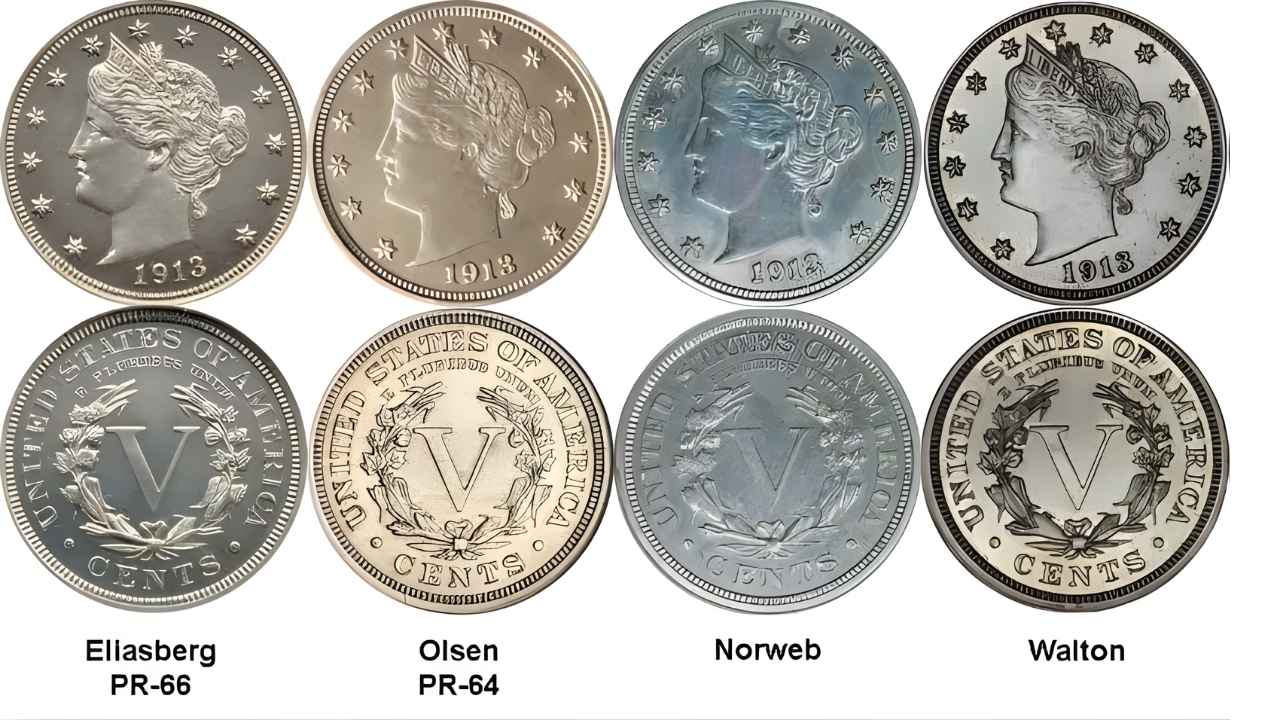
Few coins in American history have generated as much fascination as the 1913 Liberty Head nickel. Official records say the Liberty Head design ended in 1912, replaced by the Buffalo nickel the following year. Yet five Liberty Head nickels dated 1913 somehow exist, each with a documented trail of ownership, mystery, and staggering value. Over the decades, this five-cent coin has become a legend, not only for its price tag but for the unanswered questions surrounding its creation.
The End of the Liberty Head Era
The Liberty Head nickel was first introduced in 1883 and remained in circulation for nearly three decades. By the early 1910s, the U.S. Mint was ready for change. Public demand for a new design grew, and officials approved the Buffalo nickel to debut in 1913. According to Mint records, no Liberty Head nickels were authorized for production after 1912.
This clear-cut timeline is what makes the 1913 Liberty Head nickel so puzzling. Its very existence challenges official documentation, setting the stage for one of the greatest mysteries in American numismatics.
How the 1913 Liberty Nickel Came to Light
The first public appearance of the 1913 Liberty Head nickel occurred in 1920 when coin dealer Samuel Brown displayed one at a convention. Brown claimed to have obtained the coins years earlier, though he never fully explained how. He later revealed that five examples existed, all in remarkably high condition.
From that moment on, the coin world was captivated. Collectors and historians questioned how such coins could have been struck without authorization and why exactly five were made.

Theories Behind Their Creation
Several theories attempt to explain the origin of the 1913 Liberty Head nickels. One popular belief is that a Mint employee secretly struck the coins during the transition to the Buffalo nickel design. At the time, access to dies and equipment was less tightly controlled than it is today, making such an act possible.
Another theory suggests the coins were produced as presentation pieces or test strikes that were never officially recorded. Despite extensive research, no definitive proof has surfaced to confirm any single explanation, allowing speculation to thrive.
Why Only Five Are Known
Only five confirmed 1913 Liberty Head nickels exist, and each one has a distinct name tied to its ownership history. These include the Eliasberg specimen, the Walton specimen, and the Smithsonian example, among others. The small number of coins adds to their allure and ensures intense competition whenever one is offered for sale.
The fact that no additional examples have been discovered in over a century reinforces the belief that these five are the only ones that will ever exist.
Famous Owners and Public Appearances
The 1913 Liberty nickel has passed through the hands of some of the most prominent collectors in history. Industrialists, royalty, and famous numismatists have all competed to own one. The coin has also appeared in museums, television shows, and even popular culture, further cementing its legendary status.

One of the most dramatic moments in its history involved the Walton specimen, which was believed lost for decades after its owner died in a car accident. In 2003, it was authenticated and returned to the family, captivating both collectors and the general public.
Million-Dollar Auction Results
The value of the 1913 Liberty Head nickel has steadily climbed over the years. Early sales already placed it among the most expensive coins in the world, but modern auctions have pushed prices into the multi-million-dollar range. Depending on condition and provenance, a single example can sell for well over $4 million.
Collectors are not just buying a coin; they are acquiring a piece of mystery, history, and prestige that few artifacts can match.
Why This Nickel Fascinates Collectors
Beyond its rarity, the 1913 Liberty Head nickel captivates collectors because it defies official history. It represents a moment where rules were bent, records were incomplete, and human actions left behind unanswered questions. This combination of intrigue and exclusivity is rare in the numismatic world.
The coin also highlights how something as small as a five-cent piece can carry enormous historical and cultural weight.

Could Another One Still Be Out There?
While most experts agree that only five examples were ever produced, the idea that another could exist continues to spark debate. No evidence supports the existence of a sixth coin, but stories of hidden treasures and undiscovered collections keep the mystery alive.
Conclusion
The lost 1913 Liberty Head nickel stands as one of the greatest mysteries in American coinage. With its unauthorized origins, limited number, and extraordinary value, it has earned its place as a numismatic icon. More than a million-dollar collectible, it is a symbol of how history, secrecy, and chance can converge to create a legend that endures for generations.
